VINATAP JOURNAL
Cocopeat vs Coco Husk Chips: Designing Water and Air in the Root Zone
Explore how cocopeat and coco husk chips influence root-zone water and air. Learn why volume ratios, particle packing and container height matter, then use a hypothetical comparison and practical testing checklist to evaluate a blend.
Choosing cocopeat and coco husk chips is a root-zone design decision, not simply a choice between fine and coarse material. A productive blend must hold useful water between irrigations while leaving pathways for gas exchange. Its performance depends on the finished mixture, container geometry, filling practice and irrigation system together.
Design the pores, not just the ingredient list
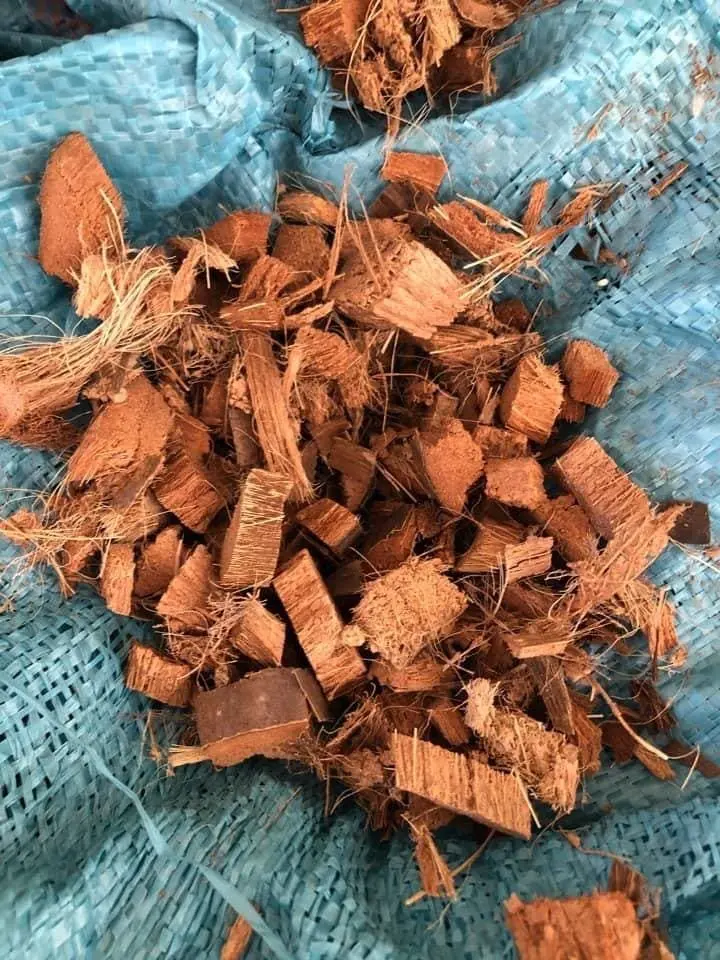
Cocopeat is the finer pith fraction of coconut husk processing; chips are larger husk pieces. Their grades can differ in fines, fiber content and particle shape. Large-looking chips are not proof that a filled container has adequate air space: the smaller particles and the way they pack still matter.
NC State explains that fines can occupy spaces between larger particles, changing pore structure and reducing the combined volume. The practical implication is that mixture properties are non-additive: a blend’s porosity cannot reliably be calculated as a weighted average of its ingredients’ porosities. Measure the finished mix. See NC State’s discussion of space-volume shrinkage.
Specify blends by volume, with hydration state and filling method defined. A 70:30 recipe means seven measured volumes of prepared cocopeat to three of prepared chips, not seven kilograms to three. After mixing, those inputs may occupy less than ten volumes. Record final yield and filled bulk density instead of assuming input volumes remain additive.
Water storage and accessible water are different
Container capacity describes water retained after saturation and drainage under defined conditions. Air-filled porosity describes the pore volume occupied by air at that stage. Neither alone describes how readily roots can extract water during drying. UMass distinguishes retained water from plant-available water and emphasizes the interaction of media, handling and watering. Read the UMass growing-media guidance.
A 2020 study hosted by USDA ARS tested coir amendments in pine bark with greenhouse hydrangea. Increasing coir improved water storage and plant-available water; the highest tested coir rate produced the highest measured photosynthetic rate. This was a particular crop and bark system, not a cocopeat–chip comparison. Its lesson is to evaluate plant response alongside substrate measurements, not copy its best amendment percentage into another blend. Read the original study.
Container height changes the same substrate
For otherwise comparable, freely draining containers, a taller substrate column generally retains a lower average proportion of water after drainage than a shorter one. The relatively wet bottom region occupies more of a shallow container. UMass explains this height effect, so physical results from one vessel cannot simply be assigned to another. See its media-column-height section.
Before changing a recipe, ask whether the problem follows the substrate or the container. Compare drain openings, actual filled depth and bench conditions. A bag resting in standing runoff is a different drainage boundary from the same bag on a clear support. Include the production container in the trial rather than evaluating everything in a convenient laboratory cup.
A hypothetical blend comparison
Imagine two experimental blends tested with identical preparation and a 3-liter filled substrate volume. These invented values illustrate calculations only; they are not research observations, VinaTap specifications or recommended ratios. Assume replicated measurements produced the following results after the same saturation and drainage procedure.
| Measurement | Blend A | Blend B |
|---|---|---|
| Cocopeat:chips input ratio, by volume | 70:30 | 50:50 |
| Water retained, percent of filled volume | 55% | 47% |
| Air-filled porosity | 18% | 26% |
| Retained water per 3-liter container | 1.65 liters | 1.41 liters |
| Air volume per 3-liter container | 0.54 liter | 0.78 liter |
For A, retained water is 3 × 0.55 = 1.65 liters; for B it is 3 × 0.47 = 1.41 liters. B has 0.24 liter less stored water and 0.24 liter more air in this invented comparison. That does not establish how much of either water reserve is accessible before stress.
If trial observations showed B drying too rapidly between available irrigation windows, its higher measured air space would not automatically make it the better choice. Conversely, A’s larger water reserve would not compensate for an excessively wet root zone under the existing schedule. Choose against a defined operational problem; do not award a blend victory from one column.
Turn a blend specification into a management trial
Separate screening from optimization
Start by screening candidate grades under the same filling and irrigation procedure. Record wetting uniformity, drainage behavior and between-container variation. Then adjust pulse timing for the promising candidates. The first stage identifies differences; the second tests whether each blend can be managed effectively. Keep those conclusions separate in the trial report.
For coco husk chips, request a particle-size distribution and information about fines, rather than relying on a photograph. For custom coco substrates, define the volume measurement procedure and the production container. Washing and buffering status also need confirmation; physical coarseness is not a chemical-quality specification.
A testing checklist before scaling up
- Hydrate representative samples consistently; document component volumes, moisture condition and the finished mixed volume.
- Measure particle-size distribution and filled bulk density; repeat fills with the staff and equipment used in production.
- Measure water retention and air space using an agreed method and stated column height. Include replicates and report variability.
- Check EC and pH by a named extraction method; investigate relevant individual ions separately.
- Monitor moisture at more than one position and calibrate sensors for the blend. Compare top, middle and bottom conditions.
- Track applied irrigation, drainage, dry-down and root development through establishment and a demanding weather period before expanding.
These are general evaluation principles, not guaranteed performance claims for VinaTap products. Share your container dimensions, crop stage, irrigation constraints and target testing method with VinaTap to discuss a sample specification that your own trial can verify.
Sources
- NC State Extension: Container Soils and Soilless Media, linked from its Substrates resource collection.
- UMass Extension: Effects of Growing Media on Water and Nutrient Management.
- Basiri Jahromi et al., 2020: Optimizing Substrate Available Water and Coir Amendment Rate in Pine Bark Substrates. Water 12, 362; DOI: 10.3390/w12020362.
Choosing VinaTap coco chips for a production trial
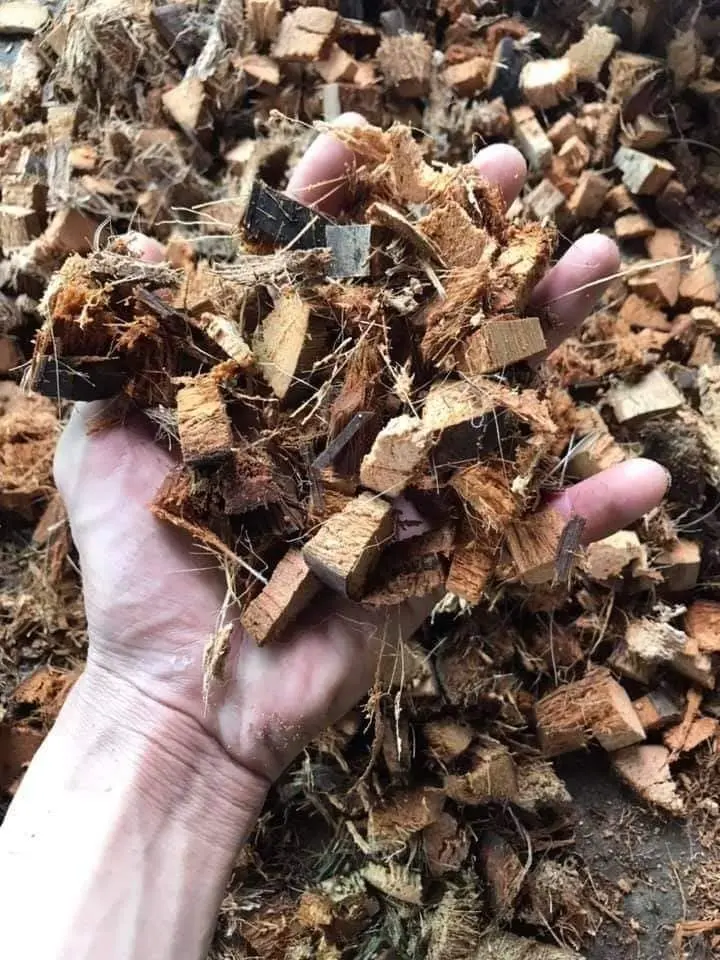
VinaTap’s confirmed particle ranges are cocopeat 0.1–6 mm, chips 5–20 mm and short fiber 1–5 cm. These describe different components. They are not interchangeable measures, and fiber length should not be reported as chip size.
Specify the screened material
Ask how the particle range is checked, how much fine material is acceptable and whether short fiber is intentionally included. Agree the measurement procedure before comparing samples. A photograph helps identify texture but cannot establish the complete size distribution of a lot.
Specify chemistry separately
State washed or unwashed material, any buffering requirement, and the EC and pH extraction method. The confirmed Low EC cocopeat value should not automatically be copied into a chip order: agree the finished chip or blend specification explicitly.
A practical mixing and irrigation trial
- Identify each sample lot and hydrate the components using the same preparation procedure.
- Measure component volumes in the agreed moisture condition. Record final mixed volume after filling.
- Use the real production pot or grow bag and the intended filling equipment.
- Compare wetting uniformity, drainage, drying behavior and root development under recorded irrigation inputs.
- Change one factor at a time. Retain a reference mix and document the reason for each adjustment.
There is no universal peat-to-chip recipe for all crops. A shallow propagation cell and a tall growing container create different conditions. Match the test to the container and management system; Oklahoma State’s growing-media overview also emphasizes the root zone’s need for water, oxygen and support.
What to send with a coco chip enquiry
Include crop and stage, container dimensions, requested chip range, fines and fiber requirements, treatment, testing method, blend basis, packaging and destination. For a premixed product, ask VinaTap to assess the finished substrate blend rather than treating ingredient names as a performance guarantee.
Are larger chips always better?
No. Evaluate the whole mixture and filled container. A coarse-looking sample can still contain fines or behave differently under another filling or watering procedure.
Can coco chips be supplied alone or in a blend?
Discuss chip supply or a custom mixture with VinaTap and confirm the agreed composition on the order.
From screened chips to mechanically dried material
VinaTap reports rotary drying for dry coco chips, with packing moisture below 15%. Screening, washing or requested buffering, and drying answer different quality questions. Confirm the chip treatment and finished blend separately; a dry appearance does not establish EC or microbiological status.
Review the VinaTap washing, optional buffering and rotary drying process and historical SGS and Vinacontrol sample results. Agree current lot testing where it forms part of your order acceptance.
Ask about a product in this article
We have included this page in your enquiry. Add your product specification, quantity and destination port before sending.