VINATAP JOURNAL
Coco Husk Chips vs Orchid Bark
Coco husk chips and orchid bark compared on water, decay, salts, fertilizer and particle size, with chip sizes and washing standards for bulk buyers.
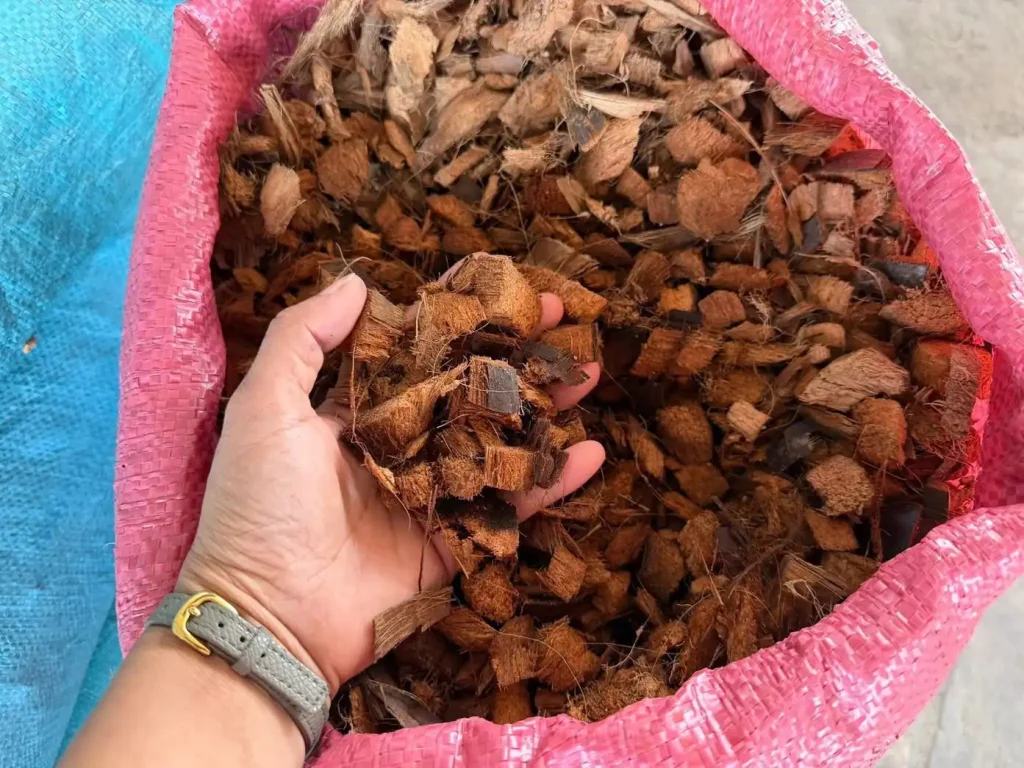
Coco husk chips and orchid bark are both coarse, open potting materials for orchids, aroids and other plants whose roots need air. Bark is the long-established standard. Husk chips can resist breakdown, but their nutrient management and acceptable salinity must be assessed for the crop and water supply. The choice of coco chips vs orchid bark comes down to watering, feeding and how clean the chips are.
| Property | Coco husk chips | Orchid bark |
|---|---|---|
| Source | Cut from coconut husk, a by-product of coconut processing | Bark of Douglas fir and other conifers |
| Main component | Lignin, slow to break down | Cellulose, broken down by wood-decay fungi |
| Water | Absorbs water; added to bark mixes to hold moisture | Drains freely; fresh bark holds little water |
| Before use | Soak in several changes of clean water, or buy washed chips | Soak overnight |
| Fertilizer | Balanced formula | Check bark condition, irrigation water and crop requirements |
| Sizes | 5–50 mm to order at VinaTap | Fine 1/4 in, medium 1/2 in, coarse 3/4 in |
| Bulk supply form | Compressed blocks and slabs, bags, jumbo bags | Loose, in bags |
The sources are American Orchid Society publications, an orchid society newsletter and university extension guides, cited in each section.
Water holding and drainage
Fir bark is the most widely used orchid medium. The American Orchid Society’s beginner series describes it as free-draining and able to hold 80% of its weight in water (judywhite, American Orchid Society).
Fresh bark is slower to take up water. Researchers writing in the society’s magazine note that fresh fir bark holds little water and moves it poorly from the bottom of the pot toward the surface (Wang, Blanchard, Lopez and Runkle, Orchids, 2007). Growers correct this by mixing in water-absorptive materials, and the authors list coconut husk chips among them, with coarse peat, perlite and diatomite.
Husk chips swell as they take up water. VinaTap’s compressed chips expand to 10–12 L per kg after watering, and smaller chips expand more. Chunky coir also has more pore space than fine coir, with better drainage and high aeration (UF/IFAS Extension).
Expect a chip-based mix to stay moist longer than fresh bark, and check the pot before watering instead of keeping a bark schedule.
How long each lasts
Bark breaks down because a wood-eating fungus feeds on it (American Orchid Society). Once fir bark begins to break down, it can hold too much water at the bottom of the pot and cause severe root rot (Wang and co-authors).
Coconut husk is mostly lignin, while wood and bark are mainly cellulose. Lignin takes many more steps to break down, so husk resists the decay that works on bark (Ned Nash, American Orchid Society).
Grower reports point the same way, with limits. Writing for the St. Augustine Orchid Society, Dr. Courtney Hackney reported that Paphiopedilum mixes containing coconut chips did not compact as his earlier mixes had. He also found a white mold in cattleya mixes with chips that made the medium water-repellent, the same problem seen in fir bark (Hackney, 2002).
None of these sources gives a lifespan in years for either material, and we do not publish one. Water quality, feeding, temperature and particle size all change the result. Repot when the mix has broken into fine particles and stays wet.
Salts and why chips are washed
Salts are the main risk with coconut husk. High salt levels are common where coconuts are grown, and coir should be washed or rinsed before use (UF/IFAS Extension). Dr. Hackney measured more than 10,000 ppm of salt in his first batch of coconut chips and soaked it for several weeks to bring the level below 20 ppm.
The American Orchid Society notes that husk chips are usually soaked in several changes of clean water before use.
Buying washed chips removes most of that work. VinaTap’s washed husk chips are supplied at an EC below 0.4 mS/cm, measured on a 1:1.5 extract by volume, and can be buffered with calcium nitrate on request. The same washing and buffering standards apply to low EC cocopeat and buffered coco coir.
Fertilizer salts can accumulate during growing. The cited Phalaenopsis article discusses drainage and leaching under its own conditions; its percentages and EC threshold are not universal targets. Define the crop, water supply and EC extraction method with the crop adviser before setting a leaching programme.
Fertilizer differs between the two
Bark decomposition can change nitrogen availability. The fungus breaking down the bark takes nitrogen that would otherwise reach the plant, so bark mixes are fed a high-nitrogen formula such as 30-10-10 (American Orchid Society). Husk does not face the same decay, and a balanced formula is the better choice for it (Ned Nash, American Orchid Society).
Chip sizes and grading
Orchid bark is sold in three grades: fine, about 1/4 inch; medium, about 1/2 inch; and coarse, about 3/4 inch. The rule for choosing is that thicker roots need larger particles (American Orchid Society).
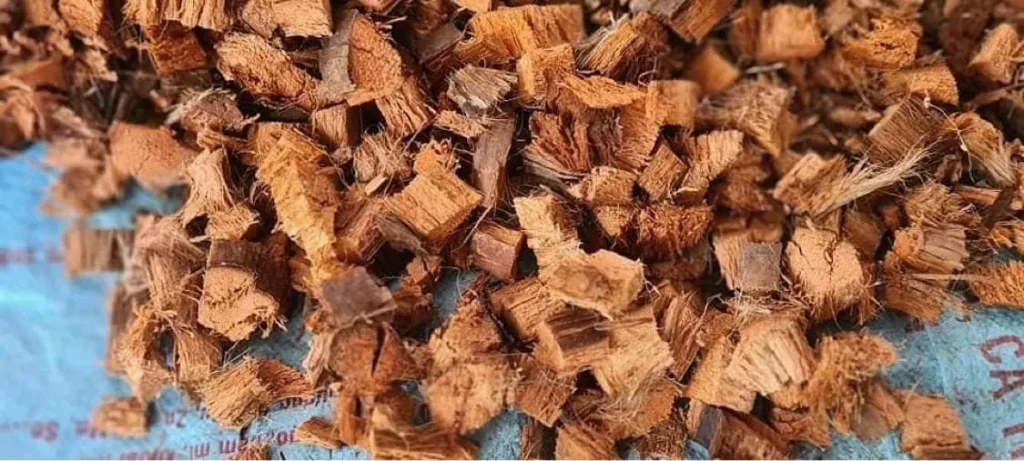
VinaTap cuts coco husk chips from 5 to 50 mm to order. The three common ranges line up with the bark grades as follows.
| Bark grade | Nearest husk chip range | Plants, by the bark guidance |
|---|---|---|
| Fine: 1/4 in, about 6 mm | 5–10 mm | Seedlings and thin-rooted orchids such as Miltoniopsis |
| Medium: 1/2 in, about 13 mm | 10–20 mm | Medium-sized plants, the majority |
| Coarse: 3/4 in, about 19 mm | 10–20 mm or 20–30 mm | Large plants such as mature cattleyas |
The match is by particle size only. The society’s guidance was written for bark, so treat it as a starting point for chips.
Even graded bark contains debris that can be sieved out (American Orchid Society). For chips, state the screening level you need. VinaTap offers 99% clean screening on request.
Orchids
Coconut husk products are used as potting media for many orchid genera (Ned Nash, American Orchid Society).
Phalaenopsis growers commonly add a water-absorptive material to bark. Early Texas A&M research found that a mix of 20% coarse peat and 80% fir bark grew plants much better than fir bark alone (Wang and co-authors). Husk chips can take that role in a bark mix, or serve as the main component with perlite or charcoal added for drainage.
Whichever material you choose, wet it before potting. A dry mix can pull water out of the roots (American Orchid Society).
Aroids and houseplants
Monstera, philodendron and other aroids are also grown in open, bark-based mixes. Clemson Cooperative Extension lists the Cornell epiphytic mix, equal parts fine Douglas fir bark, sphagnum peat moss and perlite, as suitable for Monstera, Philodendron, Dieffenbachia and bromeliads (Clemson Home & Garden Information Center).
Coir-based versions of this kind of mix use husk chips for the bark fraction and cocopeat for the peat fraction. That is a substitution by function, not a tested recipe. Trial it on a small batch first, and recheck lime and fertilizer, because coir is less acidic than peat. Clemson also advises rinsing coir thoroughly before use to avoid salinity problems.
Blending chips with bark, perlite or cocopeat
- With bark. Chips add water absorption to fresh bark.
- With perlite. Perlite is an inorganic material combined with bark and other organic media to keep a mix open.
- With cocopeat. Fine pith raises water holding and chips add pore space, so the ratio sets how wet the mix runs.
When you change the mix, review the nutrient programme as well; do not add nitrogen solely from the bark-to-chip ratio.
VinaTap blends cocopeat, husk chips and fiber to a buyer’s recipe with automatic dosing. See custom coco substrates.
Buying husk chips in bulk
VinaTap supplies husk chips from its factory in Dong Thap, Vietnam:
- Sizes: 5–50 mm to order; common ranges 5–10, 10–20 and 20–30 mm
- Washed to an EC below 0.4 mS/cm on a 1:1.5 extract by volume; buffering on request
- Moisture: below 15% at packing for the specified dry grade
- Formats: 5 kg blocks of 30 × 30 × 12 cm (±5%), slabs of 100 × 30 × 8 cm, bags of 10, 20, 50, 100 and 200 L, jumbo bags of 2,000 and 6,000 L, and big bales of 10,000 and 12,000 L on pallets
- Minimum order: one 20 ft container; chips can share a container with other VinaTap products
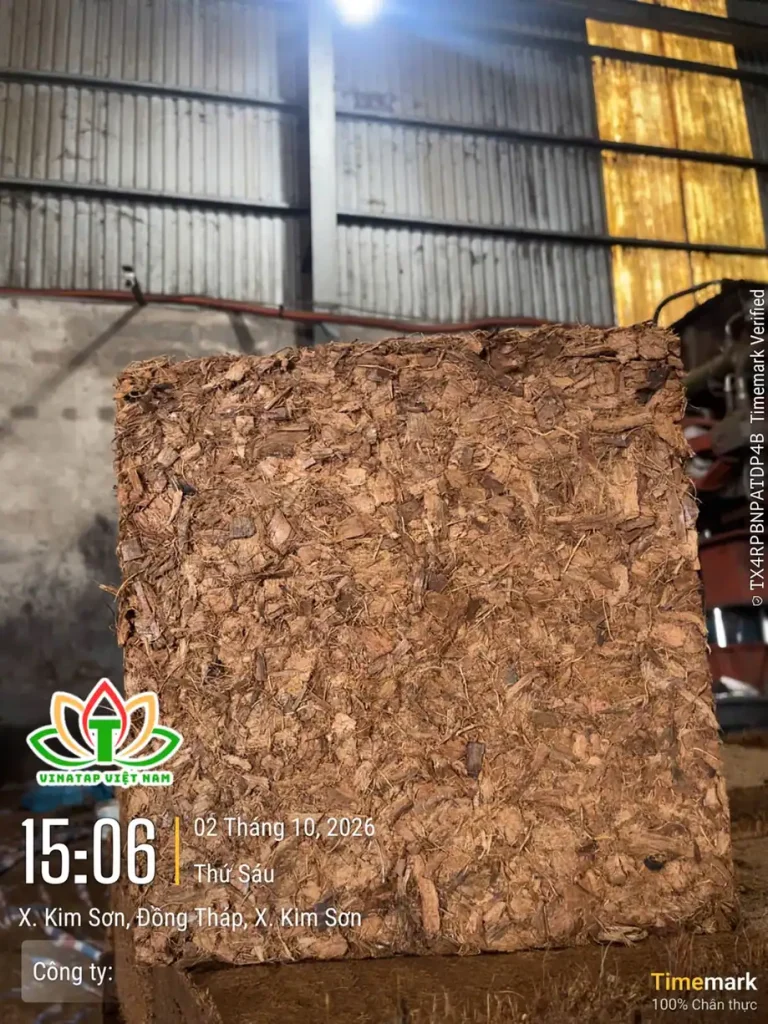
Taiwan and China are our main markets for husk chips. The full specification is on the coco husk chips page.
Common questions
Are coco husk chips better than orchid bark?
Neither is better for every grower. Husk chips absorb water and resist decay but must be free of salts. Bark drains freely but breaks down and needs more nitrogen. Chips suit growers who want a mix that stays moist longer; bark suits growers who water often.
Do coco chips need washing before use?
Yes, unless the supplier has washed them and states the EC. Unwashed chips can carry very high salt levels. VinaTap’s washed chips are supplied below 0.4 mS/cm on a 1:1.5 extract by volume. Wet any chips before potting.
What chip size suits orchids?
Match the chip to the roots: 5–10 mm for seedlings and thin-rooted orchids, 10–20 mm for most plants, and 20–30 mm for large plants with thick roots.
From material comparison to a nursery trial
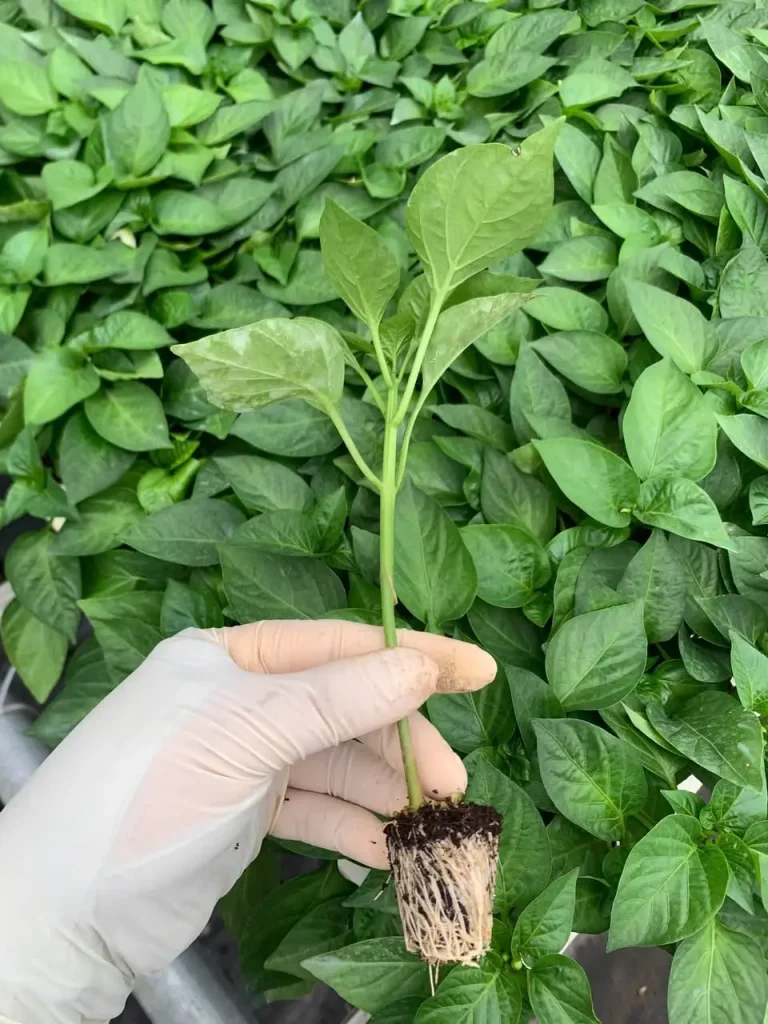
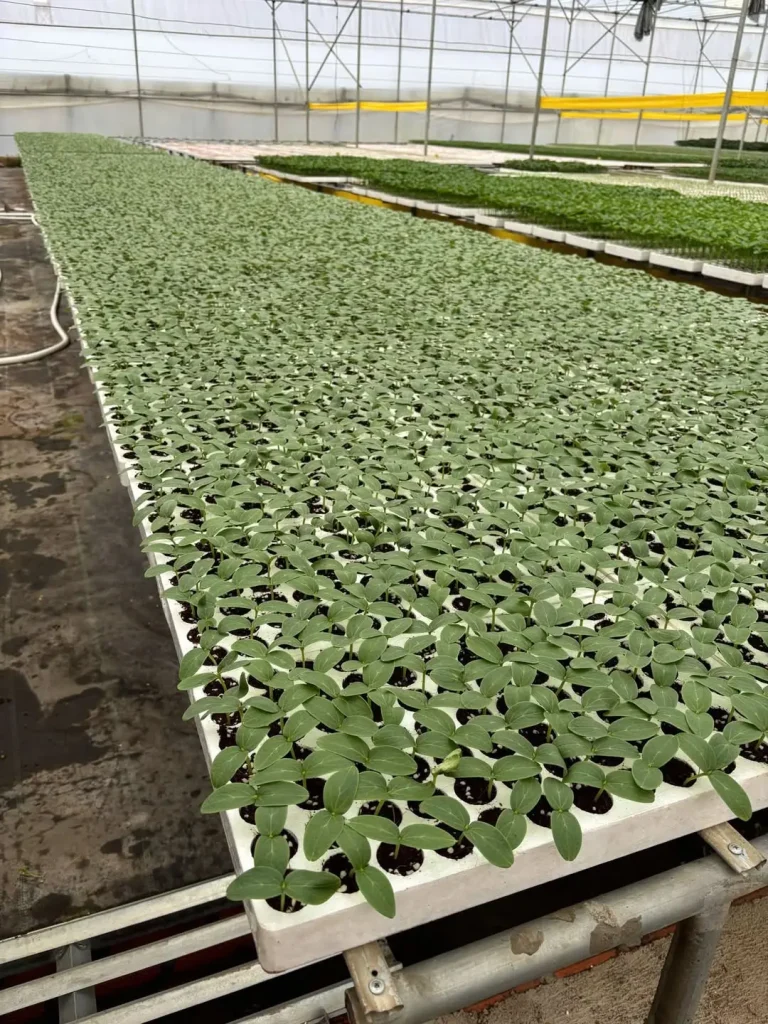
The vegetable nursery images below illustrate root-plug inspection and batch organization; they are not orchid specimens or evidence for a particular chip recipe. For orchids, assess the actual species, root condition and pot before replacing a bark mix.
Ask about a product in this article
We have included this page in your enquiry. Add your product specification, quantity and destination port before sending.