VINATAP JOURNAL
Coco Coir vs Peat Moss for Professional Growing Media
Coco coir and peat moss compared on pH, water and air, salts, stability and supply, with what to specify when replacing peat in a growing medium.
Coco coir and peat moss do the same job in a growing medium: both hold water and air around the roots and bring almost no nutrients of their own. They differ in pH, rewetting, salts and origin. Coir is less acidic and wets more easily. Peat is naturally low in salts, while coir must be washed, and for demanding crops buffered, before use.
This comparison is for growing-media producers and commercial growers who are replacing part or all of the peat in a mix. Coco coir, coco peat, cocopeat and coir pith are names for the same material.
| Property | Coco coir | Peat moss |
|---|---|---|
| Origin | By-product of coconut husk processing | Partly decomposed plants removed from bogs |
| pH | 5.5–6.8 | Acidic; may need lime to raise it |
| Water holding | High | Good, lower than coir |
| Rewetting after drying | Wets easily | Harder to rewet |
| Soluble salts | Often high until washed | Naturally low |
| Nutrient content | Low | Low |
| Breakdown in use | Slower than peat | Faster than coir |
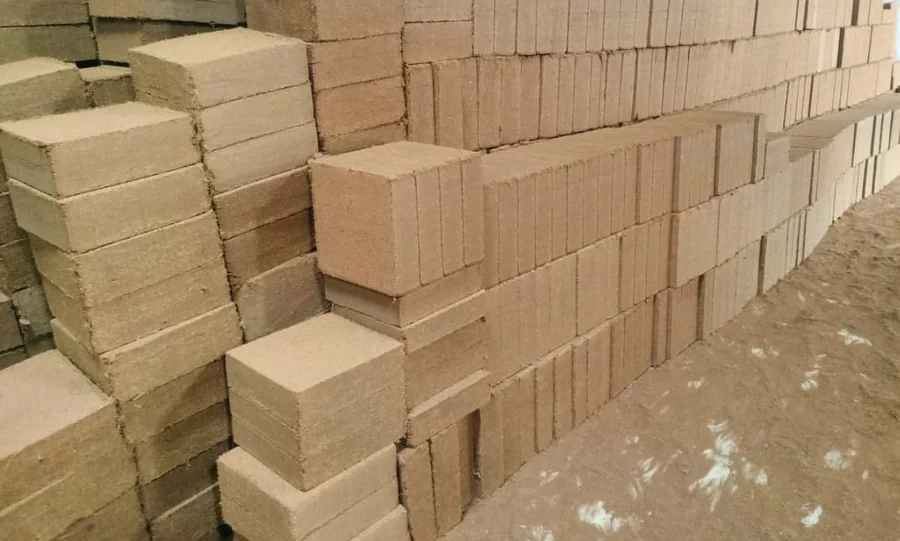
| Usual supply form | Compressed blocks, bags, jumbo bags, big bales | Compressed bales |
The pH, water and breakdown ratings follow UF/IFAS Extension and Oregon State University Extension, cited in the sections below.
Where each material comes from
Peat moss is made of partly decomposed mosses, grasses and sedges taken from bogs (UF/IFAS Extension, Common Media Used in Hydroponics). The layers take hundreds of years to form (Oregon State University Extension).
Coir is the short fiber and pith left after the long fibers are taken from coconut husks for rope and similar products. It was once a waste material that piled up at processing sites (Oregon State University Extension).
VinaTap makes cocopeat at its factory in Dong Thap, Vietnam, where the husk is crushed, washed, dried and pressed into blocks.
pH and liming
Coir has a near-neutral to slightly acidic pH of 5.5–6.8. Peat is usually acidic and, depending on its source, may need calcium carbonate to raise the pH (UF/IFAS Extension).
VinaTap’s washed and buffered grades are supplied at pH 5.5–6.5, measured on a 1:1.5 extract by volume. Unwashed high EC cocopeat is more acidic, at pH 4–5.
For a recipe, this means the lime rate set for a peat mix should be rechecked, not copied, when coir replaces peat.
Water, air and rewetting
Both materials hold a lot of water. UF/IFAS rates coir’s water holding as high and peat’s as moderate, and notes that peat does not hold water as well as coir.
The larger practical difference is rewetting. Peat is harder to rewet after it has dried than other organic media (UF/IFAS Extension). Coir wets more easily (Oregon State University Extension). This matters wherever a crop or a retail bag is allowed to dry out.
Particle size sets the balance of water and air in coir. Fine coir holds the most water. Chunky coir has more pore space, drains better and gives high aeration (UF/IFAS Extension). A producer can tune a mix by blending fine cocopeat with coco husk chips.
Salts and potassium: coir’s weak point
Salts are where peat has the advantage. High salt levels are common where coconuts are grown, so coir should be washed or rinsed before use (UF/IFAS Extension). Untreated coir pith also carries high levels of potassium and sodium (Ranaweera, Dharmakeerthi and Gunasena, 2015).
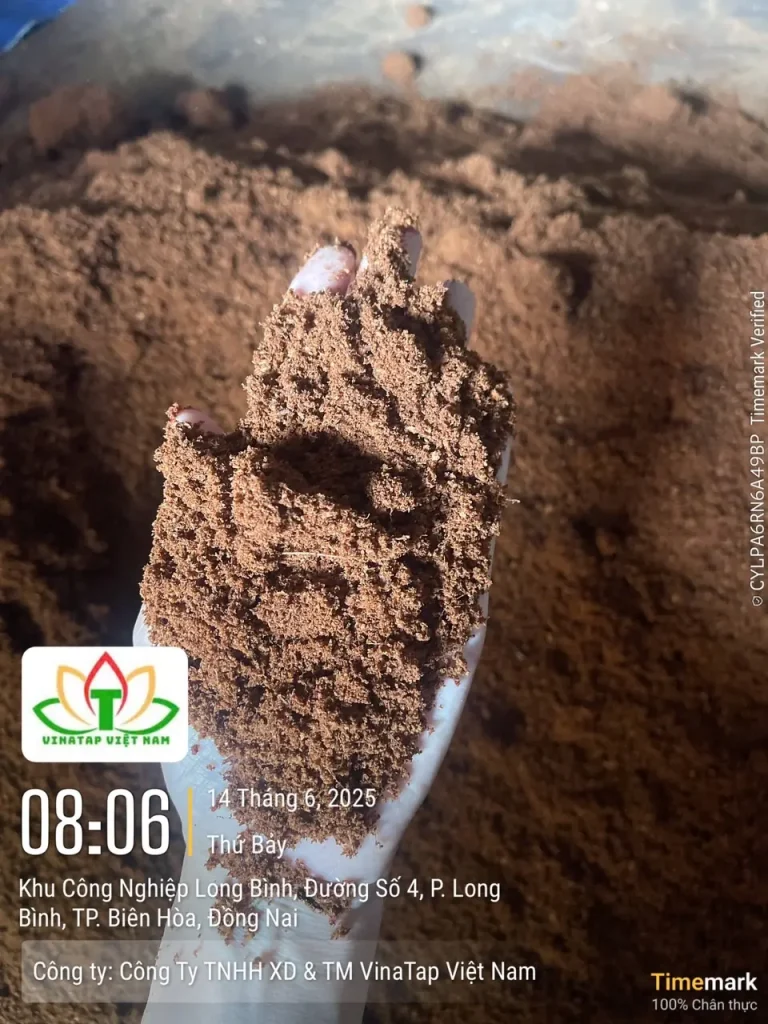
At VinaTap, unwashed cocopeat measures above 3 mS/cm. Four cycles of soaking and pressing, with 1 m³ of fresh water for every 1 m³ of cocopeat, bring it below 0.4 mS/cm. Both figures are measured on a 1:1.5 extract by volume. See low EC vs high EC cocopeat for how the two grades compare.
Washing removes dissolved salts. Potassium and sodium are also held on the coir itself, where washing mostly leaves them. Buffering with calcium nitrate exchanges them for calcium before the coir reaches the crop.
UF/IFAS also notes that coir can hold nitrogen, potassium and phosphorus, which can affect the fertilizer program. For crops fed a complete nutrient solution from the first irrigation, specify buffered coco coir. For most other professional uses, washed low EC cocopeat is the starting grade.
Structure over time
Coir decomposes more slowly than peat and withstands compression better (Oregon State University Extension). UF/IFAS describes peat as spongy and resistant to compaction, and notes that it breaks down over time, although more slowly than other organic materials.
Peat quality varies by source and can change from year to year (UF/IFAS Extension). Coir varies as well, from one processor to the next. In both cases the control is a written specification checked on every batch: EC, pH, moisture, expansion and particle size.
Replacing peat fully or partly
Researchers at Auburn University and the University of Arkansas compared the two as soil amendments and found that coir performed on par with peat (Oregon State University Extension).
That does not make coir a one-for-one swap in a finished recipe. When coir replaces peat, three things usually need adjusting:
- Lime. Coir is less acidic than peat.
- Fertilizer. Check the calcium, magnesium and potassium balance, above all with coir that has not been buffered.
- Irrigation. Coir holds more water and rewets more easily, so watering intervals change.
A staged change carries less risk: replace part of the peat, run the mix on a trial block, then raise the share of coir.
Husk chips widen the range of mixes. Blended into cocopeat, they add pore space and drainage for crops that need an open root zone. One ton of cocopeat expands to 14–15 m³ after hydration; one ton of husk chips expands to 10–12 m³.
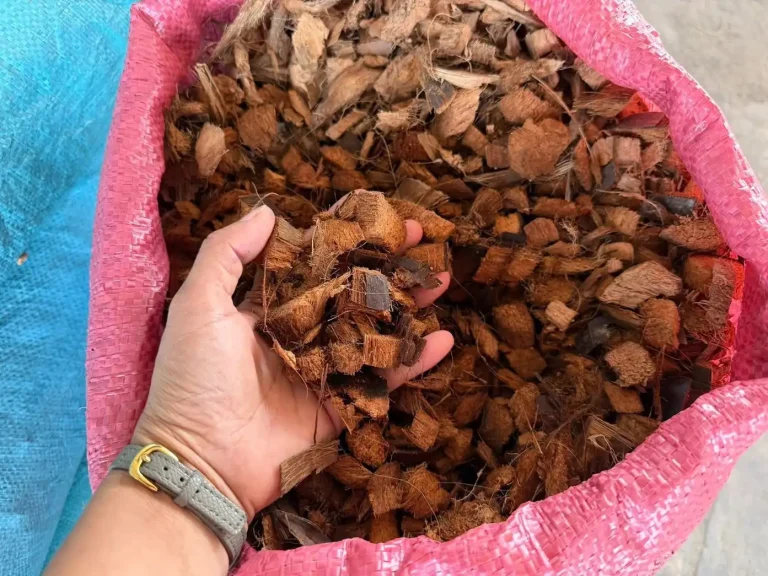
VinaTap blends cocopeat, husk chips and fiber to a buyer’s recipe with automatic dosing; see custom coco substrates. Our customers include growing-media manufacturers in China, South Korea and the United States.
Sustainability: what can and cannot be claimed
The evidence supports these statements:
- Peat takes hundreds of years to form. Wetland ecologists say it is harvested at rates that are not sustainable, while the peat industry argues that harvesting can be managed sustainably (Oregon State University Extension).
- Coir is a renewable by-product of coconut processing (UF/IFAS Extension; Oregon State University Extension).
- Rules on peat differ by country and are still changing. In the United Kingdom, as of 3 March 2026, the government had committed to setting out timeline options for legislation banning the sale of peat for horticultural use, and a private member’s bill introduced in July 2025 was awaiting its second reading (Freeths, Environmental Law Update, March 2026). The update describes a commitment and a pending bill, not a ban in force.
The evidence does not support calling coir free of environmental cost:
- Washing uses fresh water: 1 m³ for every 1 m³ of cocopeat at our factory.
- The wash water has to be managed, and the product travels by sea to most buyers.
VinaTap does not publish a carbon-footprint figure or a life-cycle comparison with peat. Ask any supplier for the evidence behind an environmental claim. Our own practices are described on the sustainability page.
What to specify when ordering coir to replace peat
- Grade: washed low EC, or washed and buffered
- EC limit and the extraction ratio it is measured at; VinaTap uses 1:1.5 by volume
- pH range
- Particle size, and the share of husk chips or fiber if you want a blend
- Format: 5 kg blocks, bags of 10 to 200 L, jumbo bags of 2,000 and 6,000 L, or big bales of 10,000 and 12,000 L on pallets
- Volume needed after expansion
A 40 HC container of 5 kg blocks carries 23.5–24 tons, which expands to at least 322 m³ of substrate. A 20 ft container carries 10.5–11 tons, about 147 m³. Producers who receive peat in big bales can order coir the same way: cocopeat big bales hold 12,000 L each, with 18 bales in a 40 HC. Reference prices for each grade are on the cocopeat price page.
Common questions
Is coco coir better than peat moss?
Not in every respect. Coir is less acidic, rewets more easily and breaks down more slowly. Peat is naturally low in salts and needs no washing. The right choice depends on the crop, the irrigation system and how well the coir has been washed and buffered.
Can coco coir replace peat completely?
In many mixes it can, and university trials have found coir on par with peat as a soil amendment. Lime, fertilizer and irrigation need adjusting, so trial the new recipe before changing a whole production line.
Is coco coir more sustainable than peat?
Coir is a renewable by-product of coconut processing, while peat takes hundreds of years to form. Coir still needs fresh water for washing and is shipped long distances, so a full comparison depends on data for the specific supply chain.
Ask about a product in this article
We have included this page in your enquiry. Add your product specification, quantity and destination port before sending.