VINATAP JOURNAL
Coco Coir Grow Bags for Commercial Tomato Production: A Buyer’s Guide
Buy coco grow bags for tomatoes: compare formats, dimensions, washed or buffered coir, sample checks, VinaTap processing and container supply from Vietnam.
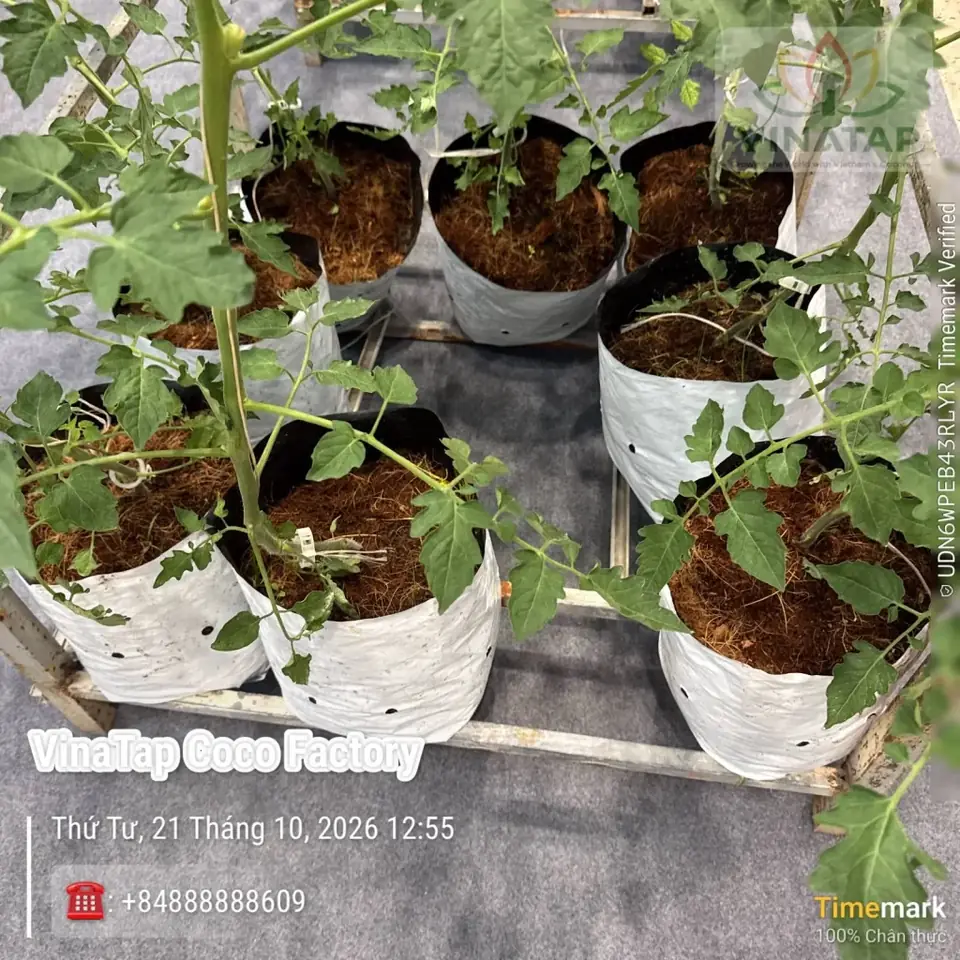
Purchasing coco grow bags for tomatoes starts with a written growing-system brief. Commercial greenhouses need a repeatable substrate specification, a bag that fits the layout and a receiving procedure that can identify variation before a full planting. VinaTap supplies custom coco coir formats from Vietnam for growers, importers and distributors.
Choose the bag around the greenhouse layout
Compare compressed long bags, direct-filled long bags and open-top bags. Compressed formats require hydration at the farm; direct-filled formats have a separately agreed moisture condition. Confirm actual filled dimensions and usable volume, not just sleeve dimensions or a nominal gallon label.
VinaTap’s long-bag options include 100 cm length and requested widths of 12, 15, 18, 20, 25 or 30 cm, with growing height customized within 10–30 cm. These are manufacturing options, not a recommended tomato plant count or root-zone volume. Send plant spacing, support layout and irrigation positions so the proposed bag can be checked against your system.
Define texture, treatment and test methods
Specify the prepared peat-to-chip composition by an agreed volume procedure. VinaTap’s component ranges are peat 0.1–6 mm, chips 5–20 mm and short fiber 1–5 cm. A component range does not establish the water and air behavior of the finished bag.
For washed Low EC cocopeat, the confirmed incoming-material EC is below 0.4 mS/cm at a 1:1 cocopeat-to-water volume extraction. Keep that test separate from a fertilized root-zone measurement. Request buffering explicitly and agree any starter nutrient charge; Low EC alone does not mean buffered.
UF/IFAS greenhouse production guidance describes coir lay-flat and upright container systems and the importance of drainage collection. Use the actual production container in a sample evaluation rather than assuming a different vessel will behave identically.
VinaTap washing, optional buffering and rotary drying
Specify processing separately from bag size. VinaTap washes Low EC cocopeat and offers calcium nitrate and magnesium buffering when requested. Its dry-product route includes a biomass-fired stainless-steel rotary drum, 1.6 m in diameter and 22 m long. Dry cocopeat and coco chips have a confirmed packing-moisture specification below 15%.
The reported 900–1,000°C inlet and 100°C outlet readings describe system measurement points. They are not measured temperatures throughout every substrate particle. See the production process and sample-specific SGS and Vinacontrol results for the evidence buyers can review.
Approve a sample before scaling the order
- Match sample identity, treatment and particle specification to the quotation.
- Hydrate compressed samples consistently and record final dimensions and usable volume.
- Check wetting uniformity, drainage access and compatibility with emitters and collection channels.
- Record repeated bag fills or expansions and define permitted variation.
- Evaluate the proposed substrate in a small, labeled tomato trial with your crop adviser, retaining a reference material.
Buying from Vietnam for established greenhouse markets
VinaTap reports existing coir customers in the Netherlands, Greece, Spain, France, Germany, the United States, Australia, New Zealand, Japan, South Korea, China and Mexico, as well as Arab-market destinations. Tell us your exact destination and port so the appropriate shipment documents and packing can be agreed. These markets are a supply background, not a claim about named tomato farms or trial results.
For custom grow bags, VinaTap’s stated starting MOQ is one 20 ft container, from 2,500 pieces; confirm the final count and loading plan for the selected format. Historical 40HC grow bag shipments have ranged from 8,000–12,000 pieces depending on dimensions. Request the actual packing list rather than applying one count to every size.
Organic-program documentation: Mekong Coco, VTV-21141
VinaTap’s historical OMRI certificate identifies Mekong Coco, product code VTV-21141, in the NOP Coconut Fiber category. The copy on file shows a listing date of 25 February 2025 and an expiration date of 1 March 2026.
Use this as a historical document reference and request current listing evidence for the exact product and formulation before organic-program purchasing. Verify applicability with your certifier and the current OMRI lists. OMRI listing is product-specific; it does not establish organic certification of a farm, current approval of every custom blend, or acceptance under every country’s organic program.
Tomato grow bag RFQ checklist
- Greenhouse layout, crop cycle and required delivery window.
- Compressed, direct-filled or open-top format and final growing dimensions.
- Peat/chip/fiber structure, washing, buffering and starter-charge requirements.
- Planting and drain-hole drawing, sleeve requirements and test methods.
- Sample acceptance criteria, quantity, packing and destination port.
Compare VinaTap grow bags, custom substrates and the three-format technical guide.
Request Samples & a Bulk Quote
Send your buying brief to vinatap@gmail.com, including destination country and port, quantity, specification and intended delivery window. Sample availability, freight, production timing and commercial terms are confirmed in the quotation.
Ask about a product in this article
We have included this page in your enquiry. Add your product specification, quantity and destination port before sending.